Reduced transport of overflow water in the West Greenland boundary current system: The role of upstream entrainment
Abstract
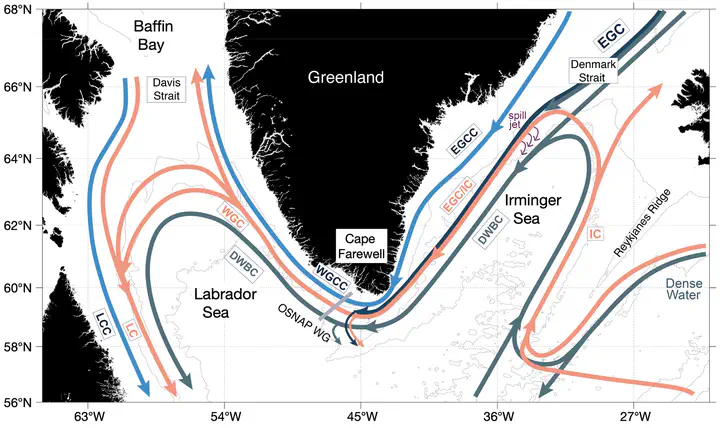
A mooring array has been maintained across the West Greenland shelf and slope since 2014 as part of the Overturning in the Subpolar North Atlantic Program (OSNAP). Here, we use the first 8 years of data to investigate the interannual variability of the two overflow water components of the deep western boundary current (DWBC): the Denmark Strait Overflow Water (DSOW) and the Northeast Atlantic Deep Water (NEADW). While the velocity structure has remained similar throughout the record, both water masses have freshened considerably, especially the NEADW salinity core. Using revised density criteria to define these two components, their transports decreased significantly between 2014 and 2022: from 6.2 to 3.8 Sv (1 Sv ≡ 106 m3 s−1) (−0.33 Sv yr−1) for the DSOW and from 5.4 to 4.1 Sv (−0.19 Sv yr−1) for the NEADW. Since the overflows across the Denmark Strait and the Faroe Bank Channel have remained steady over this period, this points to decreased entrainment downstream of the sills as a possible mechanism for the observed transport reduction south of Greenland. Using shipboard and mooring data from the two sills, and a hydrographic database for the surrounding region, we predict the downstream transport of the two DWBC components via the framework of a streamtube model. The predicted transport explains 94% of the observed DSOW trend and 63% of the observed NEADW trend. This implies that further entrainment of the NEADW must occur during its long pathlength, which would also help explain the fresher-than-predicted NEADW salinity observed at the OSNAP array.
Eleanor Frajka-Williams
Professor of Ocean Dynamics in a Changing Climate
I am a physical oceanographer who uses ocean observations to investigate ocean dynamics and circulation in a changing climate. I have a particular interest in problems spanning scales (from micro- to large-scale) or spheres (biogeosphere, cryosphere, atmosphere), and in methods that leverage traditional observations with new platforms and satellite data.