Abstract
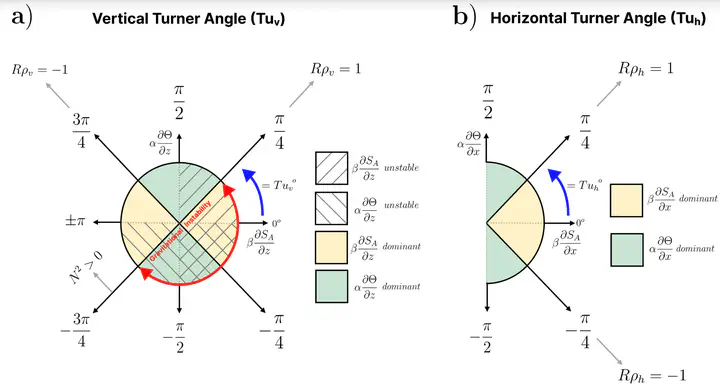
The Labrador Sea is a vital component of global ocean circulation, hosting vigorous deep convection that can mix to deeper than 2000 m. Features that drive convection are widely studied, but a lack of high-resolution, in-situ observations hinder our understanding of how small scale features influence the convective process and trigger restratification in spring, particularly at the submesoscales (< 10 km). This study assesses contributions of temperature and salinity to both vertical and horizontal stratification during early winter, convection, and spring restratification, using data collected by five underwater gliders deployed during winter 2019/20 and 2021/22. Using the Turner angle, we show that vertical stratification in the Labrador Sea shifts from salinity-stratified in early winter to temperature-unstable during convection, and back to salinity-stratified in the early restratification period. Horizontally, both warm and fresh intrusions drive lateral density anomalies during restratification, with the haline influence dominating. Wavelet analysis of these anomalies illustrates increased submesoscale activity during restratification, and comparisons of thermohaline contributions show the predominance of salinity-driven submesoscale fronts. These fronts have the potential to rapidly stratify the water column, and illustrate the importance of freshwater intrusions at submesoscales in halting convection.

Eleanor Frajka-Williams
Professor of Ocean Dynamics in a Changing Climate
I am a physical oceanographer who uses ocean observations to investigate ocean dynamics and circulation in a changing climate. I have a particular interest in problems spanning scales (from micro- to large-scale) or spheres (biogeosphere, cryosphere, atmosphere), and in methods that leverage traditional observations with new platforms and satellite data.