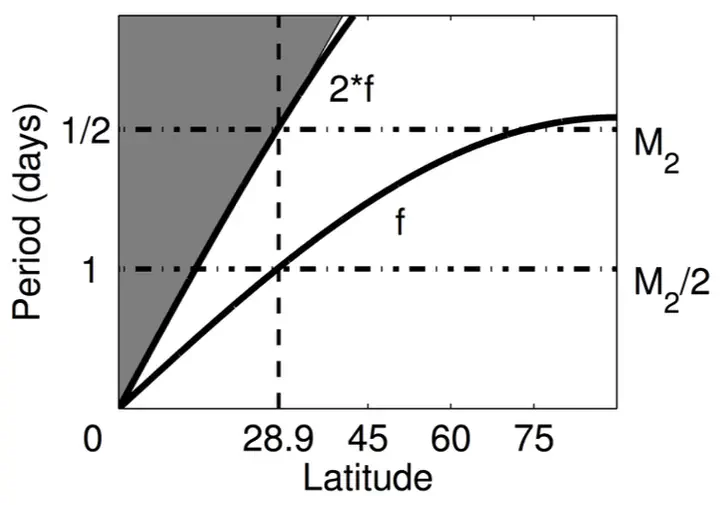
 Frequency restrictions on waves in a PSI triad as a function of latitude. The shaded region shows frequencies allowable for the parent wave of a PSI triad which are greater than twice the local Coriolis frequency. PSI of the M2 tide may occur equatorward of 2f = ω_M2 or 28.9°
Abstract
Bispectral analysis of the nonlinear resonant interaction known as parametric subharmonic instability (PSI) for a coherence semidiurnal internal tide demonstrates the ability of the bispectrum to identify and quantify the transfer rate. Assuming that the interaction is confined to a vertical plane, energy equations transform in such a way that nonlinear terms become the third-moment spectral quantity known as the bispectrum. Bispectral transfer rates computed on PSI in an idealized, fully-nonlinear, non-hydrostatic Boussinesq model compare well to model growth rates of daughter waves. Bispectra also identify the nonlinear terms responsible for energy transfer. Using resonance conditions for an M2 tide, the locus of PSI wavenumber triads is determined as a function of parent-wave frequency and wavenumbers, latitude and range of daughter-wave frequencies. The locus is used to determine the expected bispectral signal of PSI in wavenumber space. Bispectra computed using velocity profiles from the HOME experiment are relatively noisy and the signal inconclusive.

Eleanor Frajka-Williams
Professor of Ocean Dynamics in a Changing Climate
I am a physical oceanographer who uses ocean observations to investigate ocean dynamics and circulation in a changing climate. I have a particular interest in problems spanning scales (from micro- to large-scale) or spheres (biogeosphere, cryosphere, atmosphere), and in methods that leverage traditional observations with new platforms and satellite data.