Greenland's freshwater flow from ice sheet to AMOC: The known and the unknown
Abstract
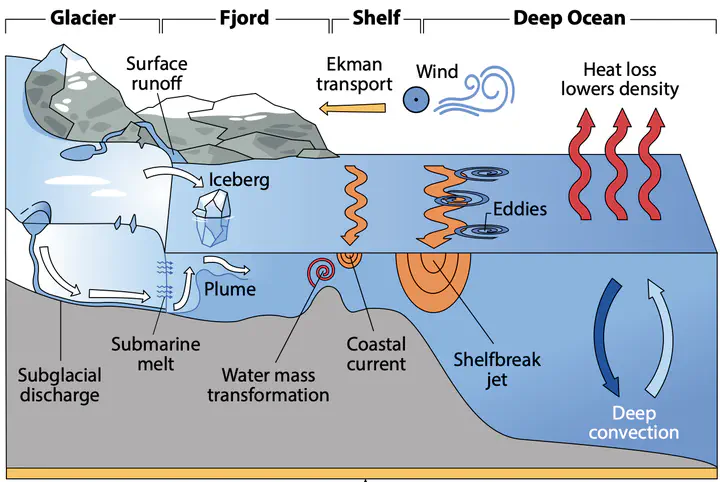
The Greenland Ice Sheet is melting at an accelerating pace under climate change, adding large additional amounts of freshwater to the ocean. This additional freshwater input has consequences not only for global sea-level rise but potentially also for the structure of the North Atlantic water column and, by extension, for the global overturning circulation. While recent model studies projecting a potential weakening or shutdown of the Atlantic Meridional Overturning Circulation (AMOC) have received widespread attention, the underlying models carry inherent uncertainties, particularly with respect to how freshwater from Greenland is represented and released in these model frameworks. In this paper, we provide an accessible review of the current state of modeling approaches, ranging from ice-sheet to fjord, shelf, and global scales. We discuss their respective strengths and limitations, illustrate key sources of uncertainty, and outline what this may mean for the interpretation of the simulated projections, to provide interdisciplinary researchers with a summary of our current understanding and highlight knowledge gaps on the effect of Greenland ice sheet melt on the ocean.

Eleanor Frajka-Williams
Professor of Ocean Dynamics in a Changing Climate
I am a physical oceanographer who uses ocean observations to investigate ocean dynamics and circulation in a changing climate. I have a particular interest in problems spanning scales (from micro- to large-scale) or spheres (biogeosphere, cryosphere, atmosphere), and in methods that leverage traditional observations with new platforms and satellite data.