Observations of upper-ocean kinetic energy transfers between near-inertial internal waves and low-frequency dynamics
Abstract
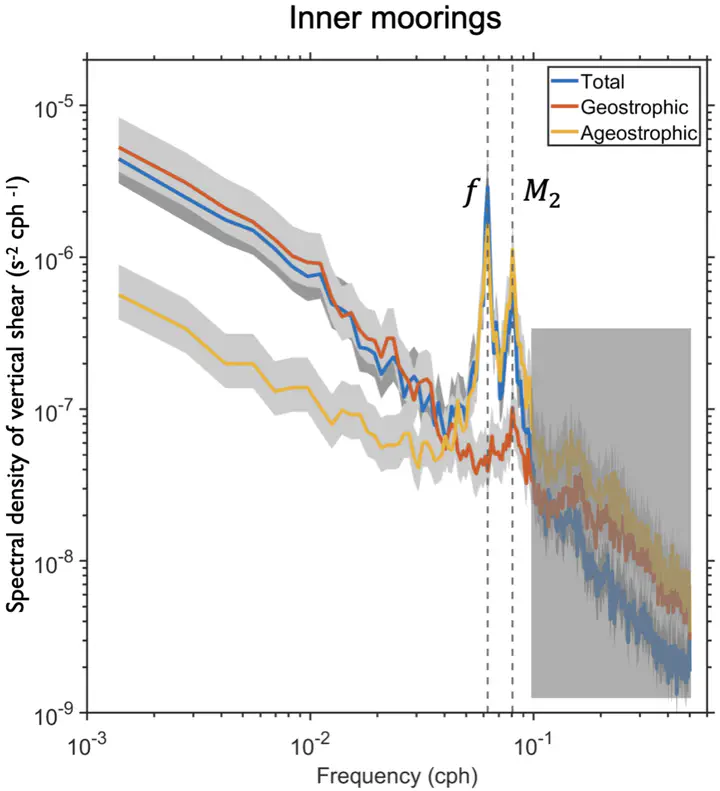
The interaction of low-frequency flows with internal waves (both tidal and near inertial) could be an important sink of the kinetic energy of large-scale ocean circulation. Using an array of nine moorings in a moderately eddy-rich region of the North Atlantic, we quantify the rate of kinetic energy exchange between low-frequency background flows (mesoscale and submesoscale subinertial motions) and the internal wave field, as well as specifically between the low-frequency background flows and near-inertial internal waves. Rates of kinetic energy transfer between subinertial motions and the full internal wave field exhibit a modest seasonal dependence, with larger transfer rates occurring during winter. Kinetic energy transfers between subinertial motions and near-inertial internal waves have a strong seasonal dependence, with larger transfers during winter, largely driven by the wintertime enhancement of near-inertial kinetic energy. In general, kinetic energy transfer rates are bidirectional, with transfers occurring both from low- to high-frequency flows and vice versa. The directionality of these transfers is linked to both the energetics of the low-frequency motions and of the internal waves, as well as their relative phasing. Coincident turbulent dissipation estimates within the moored array reveal a positive correlation with the kinetic energy transfer rate, suggestive of links between the conditions needed for turbulent processes and for promoting kinetic energy transfers between near-inertial waves and low-frequency flows.

Eleanor Frajka-Williams
Professor of Ocean Dynamics in a Changing Climate
I am a physical oceanographer who uses ocean observations to investigate ocean dynamics and circulation in a changing climate. I have a particular interest in problems spanning scales (from micro- to large-scale) or spheres (biogeosphere, cryosphere, atmosphere), and in methods that leverage traditional observations with new platforms and satellite data.