Implications for oceanographic and seafloor geodetic applications due to settling of self-calibrating bottom pressure recorders
Abstract
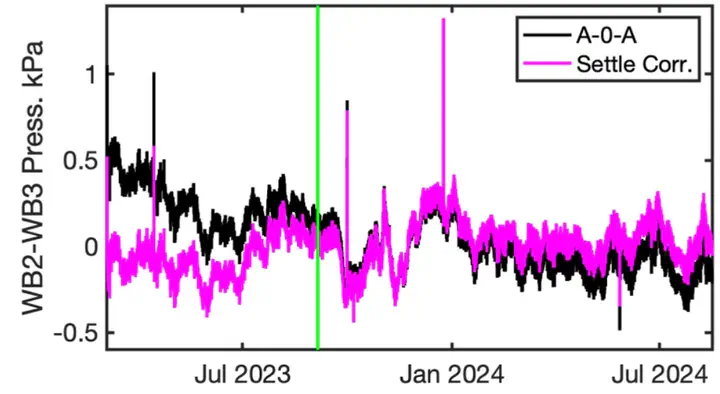
Measurements of the pressure at the bottom of the oceans are useful for understanding ocean currents and vertical motions of the seafloor caused by plate tectonics in earthquake prone and volcanically active regions. A new generation of bottom pressure recorders (BPR) are highly precise, meaning repeated measurements are very consistent. This allows detection of cm-scale changes in water depth. The new instruments solve a long-standing problem of long-term drift in BPR where the pressure measurement exponentially increases or decreases over periods of days to months. The new instruments will help to make advances in both oceanography and vertical geodesy used to study plate tectonic motions, through stable long-term observations. We present results from these new BPR deployed offshore the Bahamas and demonstrate their capabilities. However, they also sink and settle into the soft sediments of the seafloor over the first few months of deployment. We present a means of quantifying the settling and correcting the pressure records for the settling so that they can be analyzed for oceanographic purposes. This correction is an important step for full utilization of this data for future studies.
Eleanor Frajka-Williams
Professor of Ocean Dynamics in a Changing Climate
I am a physical oceanographer who uses ocean observations to investigate ocean dynamics and circulation in a changing climate. I have a particular interest in problems spanning scales (from micro- to large-scale) or spheres (biogeosphere, cryosphere, atmosphere), and in methods that leverage traditional observations with new platforms and satellite data.