Abstract
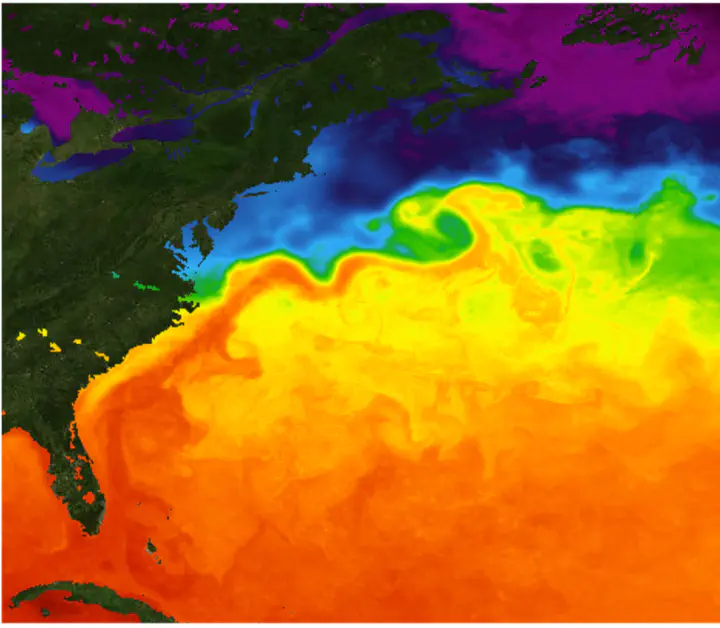
Ocean variability spans a wide range of scales, from centimeters to thousands of kilometers and from seconds to millennia. Turbulence and mixing occupy the smallest scales, with the Atlantic Meridional Overturning Circulation (AMOC) at the largest scales. However, small-scale processes can also affect the large-scale circulation. Past reviews have considered how mixing sets or affects the mean and structure of the AMOC. This review considers how mixing may affect the time variability of the AMOC. It first defines the AMOC, then discusses drivers of variability and how they are manifested in the observed overturning at the RAPID 26°N and Overturning in the Subpolar North Atlantic Program (OSNAP) arrays. It then considers how diabatic processes can change the large-scale overturning circulation.
Eleanor Frajka-Williams
Professor of Ocean Dynamics in a Changing Climate
I am a physical oceanographer who uses ocean observations to investigate ocean dynamics and circulation in a changing climate. I have a particular interest in problems spanning scales (from micro- to large-scale) or spheres (biogeosphere, cryosphere, atmosphere), and in methods that leverage traditional observations with new platforms and satellite data.