Project - UHEAT
Understanding Ocean Heat Content and Its Role in Driving Marine Heatwaves and Ecosystem Responses
Understanding Ocean Heat Content and Its Role in Driving Marine Heatwaves and Ecosystem Responses
UHEAT is an international collaborative research initiative funded under the EIG CONCERT-Japan program. The project aims to improve understanding of regional ocean heat content variations and the mechanisms driving marine heatwaves (MHWs) in the North Pacific and North Atlantic. By developing precise prediction methods for MHWs, UHEAT seeks to forecast fish distribution and help the fishing industry adapt to climate impacts.
UHH involvement: 1 July 2026 – 30 June 2029 (3 years)
Scientific Objectives
UHEAT has five main scientific objectives:
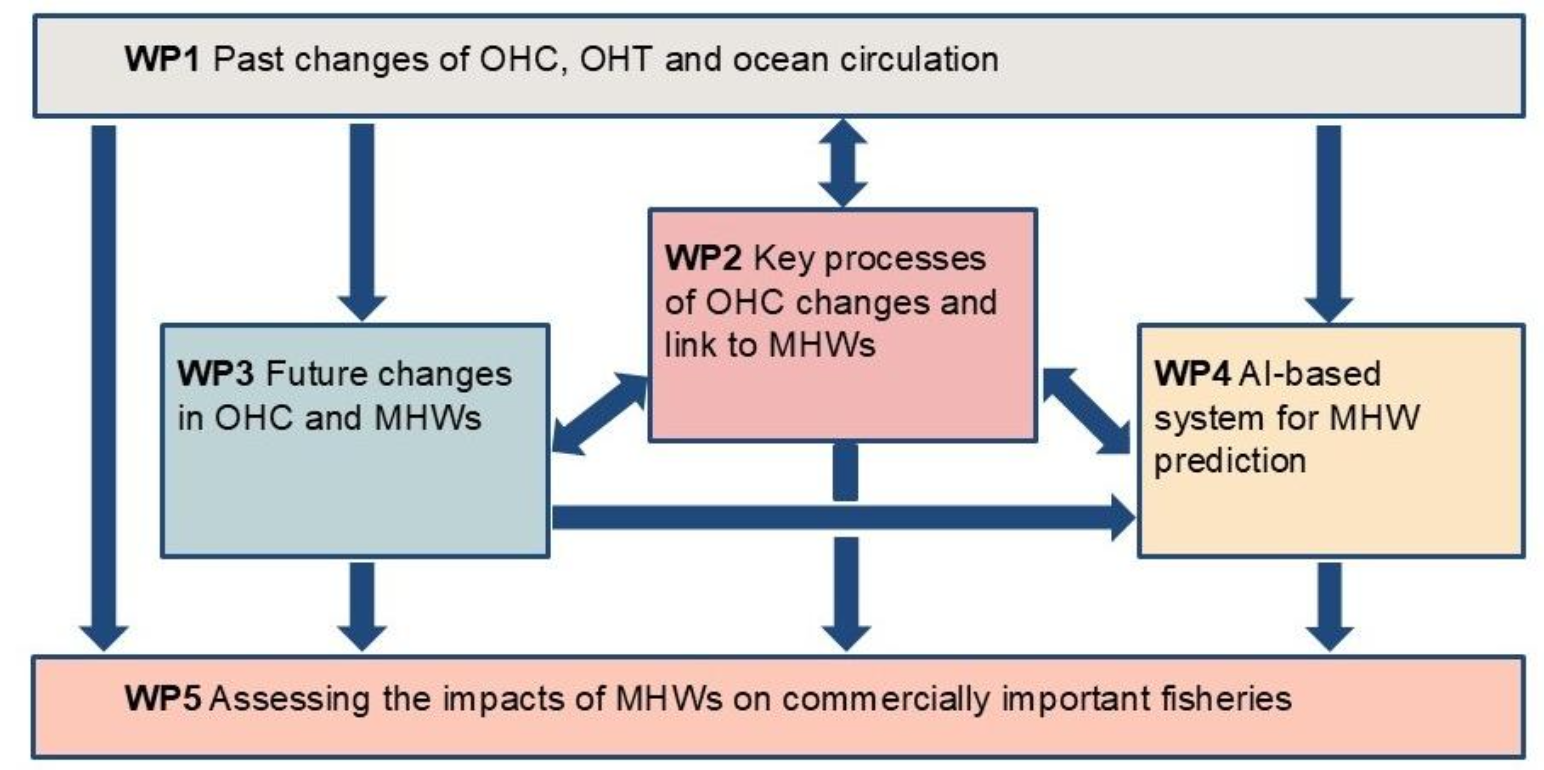
- Generate observation-based records of ocean heat content (OHC), ocean heat transport (OHT), and ocean circulation (1993 to present) across the whole Atlantic and Pacific Oceans using a Bayesian multi-observational approach.
- Determine the key processes of recent OHC changes, including their links to ocean circulation, and assess the role of such changes as a preconditioning factor to MHWs.
- Assess future changes in OHC and long-term shifts in MHW probabilities.
- Develop an AI-based system for seasonal-to-multiyear forecast of MHWs conditional on OHC, OHT, and SST fields.
- Predict the influence of MHWs on the distribution and migration routes of commercially important fishery resources in Japan and Europe.
Hamburg’s Role
UHH (led by PI Eleanor Frajka-Williams) leads WP2 and plays a key role in WP1. The UHH postdoc will be primarily responsible for the tasks described below.
WP1: Past Changes of OHC, OHT and Ocean Circulation (lead: UIB)
WP1 builds on an existing Bayesian hierarchical framework developed for the Atlantic (Calafat et al., 2025) that integrates hydrography, altimetry, and gravimetry (GRACE) with surface heat flux data to generate gridded estimates of OHC changes, OHT convergence, and meridional OHT across multiple latitude lines. The framework will be extended to the Pacific Ocean, to earlier periods back to 1993 by incorporating additional ocean mass datasets, and to enable separation of upper and deep OHC contributions. The Bayesian model also provides consistent fields of sea level and ocean mass used to approximate ocean circulation as a 2-layer fluid, yielding barotropic and baroclinic estimates.
- T1.1: Collect and process observational data. (UIB)
- T1.2: Extend the Bayesian framework to the Pacific basin and earlier periods back to 1993. (UIB)
- T1.3: Develop the multi-observational approach to estimate ocean circulation. (UHH, with UIB contributing)
- T1.4: Generate gridded estimates of OHC, OHT, OHT convergence, and ocean circulation. (UIB, with UHH contributing)
WP2: Key Processes of OHC Changes and Link to MHWs (lead: UHH)
Bringing together observation-based data from WP1 and a suite of high-resolution models and reanalyses, WP2 determines the processes of OHC changes since 1993. The core model simulations come from the HighResMIP project (Haarsma et al., 2016), supplemented with state-of-the-art reanalyses (e.g., ECMWF ORAS5 – Zuo et al., 2019).
- T2.1: Assemble and preprocess outputs from HighResMIP simulations and ocean reanalyses. (UHH)
- T2.2: Compute regional heat budgets to quantify the roles of OHT versus surface heat fluxes. (UIB, with UHH and HKU contributing)
- T2.3: Assess links between OHC changes, OHT, AMOC, and gyre circulations; map horizontal heat transport pathways by combining surface geostrophic velocities from altimetric sea level with Bayesian estimates of upper OHT convergence. (UHH, with UIB contributing)
- T2.4: Evaluate spatiotemporal coherence of OHC and diagnose the role of local vs. remote oceanic forcing. (UHH)
- T2.5: Quantify links between OHC changes and MHW occurrence. (UIB, with UHH and HKU contributing)
UHH ensures that observational, modelling, and analytical approaches are effectively integrated across all partners.
Key Researchers
UIB (Spain)
- Francisco-Jaime Mir-Calafat (Principal Investigator) — Associate Professor, University of the Balearic Islands
- Marta Marcos (Co-Investigator) — University of the Balearic Islands
UHH (Germany)
- Eleanor Frajka-Williams (Co-Investigator) — Professor and Head of Experimental Oceanography, University of Hamburg
HKU (Japan)
- Hiroshi Kuroda (Project Leader) — Associate Professor, Institute of Low Temperature Science, Hokkaido University
- Yoshi Sasaki (Co-Investigator) — Hokkaido University
- Shoshiro Minobe (Collaborator) — Hokkaido University
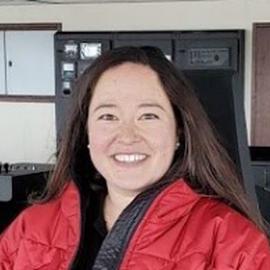
Eleanor Frajka-Williams
Professor of Ocean Dynamics in a Changing Climate
I am a physical oceanographer who uses ocean observations to investigate ocean dynamics and circulation in a changing climate. I have a particular interest in problems spanning scales (from micro- to large-scale) or spheres (biogeosphere, cryosphere, atmosphere), and in methods that leverage traditional observations with new platforms and satellite data.