The Experimental Oceanography group is hiring a postdoctoral researcher (TV-L E13, full time, suitable for part-time; 21 months from 1 February 2027). Deadline to apply: 4 December 2026. Please contact Eleanor with any questions.
To apply, please see the advert on the University webpage: Research Associate for the Project “EPOC & UHEAT”
The post
The work begins in EPOC, a Horizon Europe project coordinated at the University of Hamburg, asking where the overturning and its heat transport vary independently with latitude, and what the answer implies for the choice of latitudes in a sustained in situ observing system. It continues in UHEAT (Understanding Ocean Heat Content and Its Role in Driving Marine Heatwaves and Ecosystem Responses), funded under EIG CONCERT-Japan with partners at the University of the Balearic Islands/IMEDEA (Spain) and Hokkaido University (Japan).
Your responsibilities
- establish where the overturning and its heat transport vary independently with latitude, and so where sustained in situ measurement is needed; test candidate choices by subsampling a reanalysis at those locations, e.g. with the openly available OceanOSSE code
- build the evidence for that from two directions: a multi-observational estimate of ocean circulation, combining altimetric sea level with ocean-mass fields from the project’s Bayesian framework to approximate the circulation as a two-layer, barotropic and baroclinic system; and the coherence of ocean heat content in space and time, separating locally from remotely forced change
- assemble and analyze the ocean reanalyses this rests on (e.g. ORAS5, GLORYS12), and relate regional ocean heat content change to heat transport convergence, the AMOC and the gyre circulations
- contribute to the regional heat budgets and to the link between ocean heat content change and the occurrence of marine heatwaves, led by partners in Spain
- contribute to open-source software used across the community, including amocatlas, the package of AMOC observing-array records maintained in the group
- coordinate Work Package 2 across the consortium, publish results, present at project meetings and international conferences, and work with MSc students linked to the project
Your profile
- PhD in physical oceanography, climate science, applied mathematics or a related field
- experience analyzing ocean reanalyses or model output, or large observational datasets (Argo, altimetry, GRACE)
- familiarity with ocean heat budgets, meridional overturning or gyre dynamics
- strong Python skills and comfort working on an HPC system
- code written for other people to use: version control with Git, work in the open on GitHub, and analysis code that is documented, tested, and released with the papers it supports; the group maintains open packages for AMOC, mooring and glider data, and what you build is expected to outlive the contract
- written and spoken English at working level; German is not required
- willingness to travel to project meetings in Japan and Spain
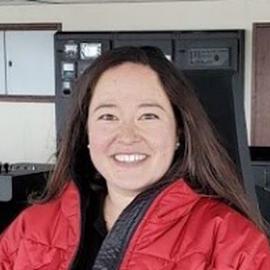
Eleanor Frajka-Williams
Professor of Ocean Dynamics in a Changing Climate
I am a physical oceanographer who uses ocean observations to investigate ocean dynamics and circulation in a changing climate. I have a particular interest in problems spanning scales (from micro- to large-scale) or spheres (biogeosphere, cryosphere, atmosphere), and in methods that leverage traditional observations with new platforms and satellite data.